Showing posts with label Books. Show all posts

Sunday, March 29, 2009

Down and Out


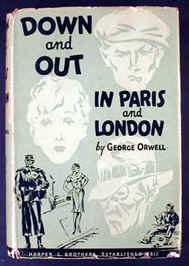
I've been reading George Orwell's "Down and Out in Paris and London," which includes harrowing, stomach-turning accounts of his experiences behind the scenes at a fancy French restaurant: oppressive working conditions, food dropped in filth, picked up, dusted off and served, exorbitant mark ups, systemic pilferage of food and drink.

At times the book uncannily echoes Tony Bourdain's "Kitchen Confidential," which makes one realize restaurant culture hasn't changed all that much since the 1930s.

Here is an especially off-putting passage:

In the kitchen, the dirt was the worst. It is not a figure of speech, it is more a mere statement of fact to say that a French cook will spit in the soup -- that is if he is not going to drink it himself. He is an artist, but his art is not cleanliness, for food, to look smart, needs dirty treatment. When a steak, for instance, is brought up for the head cook's inspection, he does not handle it with a fork. He picks it up in his fingers and slaps it down, runs his thumb around the disk and licks it to taste the gravy, runs it around again and licks again, then steps back and contemplates the piece of meat like an artist judging a picture, then presses it lovingly into place with this fat, pink fingers, every one of which he has licked a hundred times that morning. When he is satisfied, he takes a cloth and wipes his fingerprints from the dish, and hands it to the waiter. And the waiter, of course, dips his fingers into the gravy -- his nasty, greasy fingers which he is forever running through his brilliantined hair. Whenever one pays more than, say, 10 francs for a dish of meat in Paris, one may be certain it has been fingered in this manner.
I'm feeling a little sick after writing that.

But the book is about far more than the disgusting realities of French bistros of the era. Based on Orwell's experiences as a tramp in Paris and London, it is a chronicle of poverty and hunger unlike anyone has experienced in the West since the Depression. Orwell's protagonist literally almost starves to death, reduced to pawning the very clothes off his back to buy a bag of potatoes or a loaf of bread and milk to survive.

As tough as things are now, the book is a useful reminder that conditions don't even remotely compare to what the poor experienced 75 years ago. Let's hope it stays that way.

Overall, the book is excellent although Orwell's idealistic socialism -- such as when he essentially argues that fancy restaurants should be shut down because they oppress lower rung workers -- renders it somewhat dated. Then again, maybe not, given recent events, Not of course that I would ever suggest shuttering the French Laundry or Le Cirque.

Sunday, January 25, 2009

Old School

I just finished a book called "See You in a Hundred Years," the story of a New York writer, his wife and their small child who chuck their 21st century stresses and conveniences to live on a Virginia farm in 1900. My wife gave me the book after meeting the author Logan Ward at a writers conference.

The book is about "an experiment" -- as Ward calls it: Can the family live for a year without electricity, indoor plumbing, a phone or a car, while producing most, if not all their food?

I have mixed feelings about such ventures. On one hand I find them fascinating because I love history and because my mother grew up on a subsistence farm in Iowa during the Depression. Since I was a little boy, she told me about the outhouse, the outdoor shower and the pot belly stove that was their only source of heat. The family grew much of its own food (Like the Wards, my grandmother was a fanatical canner her entire life), had a milk cow named Old Boss who had to be led by chain because she ate rope and chickens that produced eggs and were routinely Henry VIII-thed into the pot for dinner.

But my mother's memories are generally not happy ones. She hated the farm, the endless drudgery,the narrowness of small town life and the hardships of the Depression. When idealistic middle class kids went "back to the land" in the late 1960s and early 1970s, my mother laughed derisively. "Just you wait," she said contemptuously. "They'll find out."

She was right. Most communes collapsed as soon as the hippies realized they had to get up at 6 a.m. to milk cows and flush toilets were not part of the program.

So while I am fascinated by "experiments" like the one in "See You in a Hundred Years," they also evoke in me a measure of revulsion and even contempt.

But Logan and his wife, while they were clearly naive and unprepared in some ways, strike a pretty fair balance. Both have living relatives who grew up poor at the edge of the era they are recreating, so they had a decent idea of what they were getting into. And Ward is clear-eyed in his descriptions of the endless hard work, chamber pots, goat droppings and the challenges of farming without pesticides.

Some of the most interesting parts of the book relate to food. Indeed, while I am skeptical of such returns to the past, I do believe that much flavor, goodness and diversity has been lost in the rush to factory farming. The Wards' experiment seems to confirm this. After a slow start, their garden yields a bounty of superior-tasting cabbage, carrots, tomatoes and corn. The goats they keep produce superb cheese and the fresh chicken eggs are tasty and nutritious.

At the end of the book, Logan recounts a conversation with a friend that I think puts the family's "experiment" in the right perspective:

I rattle the ice in my glass and turn to John. "Why bother with past?
He is silent for a minute. "When you think about it, the past is all we have. It's where we've been," he says. "And we sure as hell don't where we're going."
"Then it's a guide for how to live?" I ask.
"I don't think that the past should dictate the future, but it's a good foundation. Passing down culture from generation to generation is one of the things that separates us from other creatures. Personally, I want that link to the past. We find ourselves through the long trail of those who came before us."
Those who don't care about the past are disoriented, he says, showing no regard for the land, for humanity, for themselves.
I have only scratched the surface of this excellent book.

Sunday, January 4, 2009

Papa's Treat

I started cleaning out the basement yesterday, my project for the winter, when I came across my old copy of "Green Hills of Africa." A superb book, stellar, sparkling writing from the beginning to the end, Hemingway at his absolute best.

Regarding this blog, I immediately recalled a passage in which Papa lovely describes German beer with "silver foil" around the neck. It took some skimming, but I found the passage. It's as good as I recall:

"Hey, M'Cola," I said. "Beer?"

"N'Dio," he said with great force, and from the chop box one of the natives had carried on his head produced in its straw casing, a bottle of German beer, one of the sixty-four bottles Dan had bought from the German trading station. Its neck was wrapped in silver foil and on its black and yellow label was a horseman in armor. It was still cool from the night and opened by the tin opener, it creamed into three cups, thick-foamed, full bodied.

"No," Pop said. "Very bad for the liver."

"Come on."

"All right."

We all drank and when M'Cola opened the second bottle Pop refused firmly.

"Go on. It means more to you. I'm going to take a nap."

"Poor old Mama?"

"All for me," I said. M'Cola smiled and shook his head at this drinking. I lay back against a tree and watched the wind bringing the clouds and drank the beer slowly out of the bottle. It was cooler that way and it was excellent beer.
Described like the true hard-core alcoholic that he was. Just reading it that leaves you dying for a cold one.

Friday, January 2, 2009

The Hunger of Memory

I recently finished The Man in the White Sharkskin Suit one of the best and most moving books I have read in a long time. It is the heartbreaking story of an Egyptian Jewish family's privileged life in Cairo destroyed by strongman Gamal Abdel Nasser and turmoil in the Middle East.

Once part of the Cairo elite, the proud Lagnado family, which traced its roots to Aleppo in Syria, is forced to flee in the early 1960s along with most of that nation's 80,000 Jews. After a stop in Paris, the family ends up penniless in Brooklyn where the author's father, a one time entrepreneur extraordinaire and man about town, fails spectacularly. Ravaged by various ailments and pining for the beloved Cairo he will never see again, the father is forced to eek out a living selling neckties and earning tiny commissions on bolts of cloth.

The book, a memoir by the family's youngest member, Wall Street Journal reporter Lucette Lagnado, includes repeated luscious, loving descriptions of the food of her childhood. Indeed, food, the longing, memories and pleasures it evokes, is a source of both happiness and sadness throughout the book. Many of Lagnado's most memorable passages describe her legendary grandmother's cooking and the central, spiritual, event supernatural role that food played in the life of her family. Take this passage:

My grandmother Zarifa believed that certain foods possessed magical powers.

Bananas and raw eggs were at the top of her list, along with almonds, sour cherries, olives, and, above all, mesh-mesh, ripe, luscious apricots. Zarifa wold slip them into virtually any dish on Primus, and she was such a gifted cook that every course she prepared from simple grilled meats to elaborate stews and roasts, emitted a mysterious vaguely fruity aroma.

Anyone who came dine at Malaka Nazli could count on a transcendent experience. What was in there? they’d wonder, amazed at their sense of absolute well-being.

At one point in the 1940s, Lucette's uncle feels desperately ill and resorts to the standard family cure-all: a cappuccino at Groppi, a legendary pastry shop that makes repeated appearances in the book. When the coffee fails to revive, Uncle Salomone visits a doctor who diagnoses pleurisy and prescribes bed rest and as much much food as he can eat. The subsequent cure, administered by Lucette's grandmother, has to be read to be believed.

Later, struggling in exile in Brooklyn, the family finally lands its first apartment, owned by fellow Syrian Jews. It is a sweet that makes them feel at home for the first time since arriving in America:

Efadolou,” they cried, Arabic for welcome, and with typical Syrian hospitality, they offered us a platter of khak, salty ring-shaped biscuits covered in sesame. We hadn’t eaten them since Cairo, and biting into the delicious treats made us realize that we were both far from home and that we’d finally arrived.
This book is a pleasure and a revelation many levels, not the least of which the deep meaning that food can have in our lives, especially those who have left their homes to start a new life elsewhere. It led me to pull out an old Middle Eastern cookbook I got from God knows where and try a recipe. I will try more and report on the results.

In the meantime, if you are interested in Middle Eastern Jewish food, here is a link to a New Yorker Magazine piece on the food of King's Highway, the Brooklyn neighborhood where many Syrian Jews settled.